
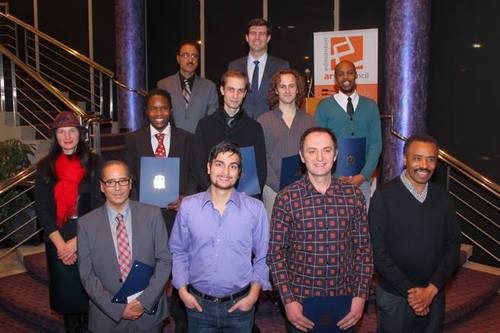
Speaking with Ahmed Ali (aka Knowmadic), you get the sense that the poet, writer, actor and comedian is a continuous learner and not one to limit himself to a single identity. In his school days, Ali combined humour with his self-described “crazy imagination” to make his classmates laugh. He was inspired in part by his English as a Second Language (ESL) teacher, who encouraged him think about pursuing the arts after he was rewarded for his creativity. His father and his upbringing have also been obvious influences.
“Coming from my background, there’s a lot of oral tradition,” explains Ali, who was born in Somalia. “Our language wasn’t written until 1979, so we have a lot of folk tales and proverbs and metaphors in our language. That’s how we passed stories down […] And my father would lecture me a lot growing up and talk about art and different songs.”
Ali has not only been nomadic in the cultural sense, he’s also been nomadic when it comes to arts disciplines. He began writing in his early teens, and at age 16 became involved in theatre. When he was 20, he attended Humber College in Toronto to study comedy, before dabbling in spoken-word poetry five years ago upon arriving to Edmonton from Toronto.
Despite his many gifts, Ali describes his artistic journey as “rough” and far from being complete.
 “The most difficult challenges [were] the knowledge of where to go for the arts and also having the knowledge of how to deal with arts, ‘cause I don’t have the business mentality. I’ve never had anybody in my family who’s a successful artist, nobody in my culture that I knew directly that I could speak to who had any success,” he says. “Especially now that I’m doing spoken word poetry and it’s been a long time, there’s still barriers. People don’t look at me like, ‘Oh my God you’re a great writer!’ They look at me like, ‘Oh my God, a Muslim man who knows how to speak?’ I know it sounds ridiculous, but it almost comes off like that. It doesn’t come off like ‘Wow, great work!’ So there’s always that cultural barrier.”

Despite that, Ali says he sees struggles as opportunities for growth and has managed to turn his art into his career. He is one of the founding members of theBreath in Poetry Collective, which provides a weekly platform for poetry and music and made a return from the holidays in early February. The idea behind the collective began in 2009 with fellow poet Titilope Sonuga. During the first year of hosting poetry gatherings together at Rouge Lounge, the collective struggled to get more than five poets out each week. The following year, the attendees grew to 20, then doubled in size after that. This year, Ali observes more than 70 people who are coming out to Rouge Lounge.
“Now, we have probably too many poets, which is a good problem!” Ali notes that the proportion of new audience members can be as high as 75% on a given week. “So their friends are spreading it. It’s a beautiful thing.”
Ali has received much recognition for his work in the arts and within the community. He was recently chosen to be one of the Alberta Council for Global Cooperation (ACGC)’s Top 30 Under 30, and was a recipient of the Edmonton Arts Council’s 2013 Cultural Diversity in the Arts Award. He also received an EAC Travel Grant to attend the Hillside Festival in Guelph in 2013. With the Cultural Diversity in the Arts Award, Ali hopes to publish a book, create a record and educational videos.

Ali credits a huge part of his success as an artist to living in Edmonton. He returns to the Somali tradition of using proverbs to describe the city’s support for the arts.
“I say, ‘An artist’s soil is their community: if they’re not growing, they’re in the wrong field’. In my opinion, Edmonton is very fertile; it’s very supportive. Being an artist, if it wasn’t for Edmonton, I wouldn’t be who I am today. I’ve been here for 5 years, and I’ve been able to accomplish what I have because I’m in Edmonton. I don’t think I could have done it anywhere else.”
On top of all his existing projects, Ali is also currently working with Alberta Education, the Edmonton Public School Board, and the Alberta Teacher’s Association to bring diversity, culture and optimism to the classroom. He provides weekly workshops to students at Jasper Place High School, and throughout the month of February for Black History Month, he provided poetry workshops to students at M.E. LaZerte High School. As a final project, students will present their poems at an assembly for anti-bullying.
When it comes to encouraging newcomer artists, particularly youth, Ali offers some poetic words of wisdom:
“It is honestly just to say: Never think of your identity or your culture or your language as a barrier. Once you do that, you allow your mind to perceive that and become a reality. In my honest opinion, the greatest deficit is our own mind. We have to overcome, ‘cause as minorities – yeah, we went through customs, and we go through customs; we were questioned a lot, but we customs ourselves all..day..long! We go through customs everyday! We ask ourselves, ‘Where you going? Why are you going there? Are you white enough? Are you black enough?’ So the biggest problem is overcoming your own insecurities and realizing that you are an original copy in a world of 7 billion people and that nobody thinks the way you do; nobody speaks the way you do; nobody lives the way you do. And that is why it is important to continue your art regardless of how difficult it gets. Growth comes in spurts; mistakes are important. Optimism 100%. If you look at things as a growth, and if you always look at things as a means to get better, you’ll never lose.”

Check out Ahmed Knowmadic through:
Twitter: www.twitter.com/Aknowmadic Facebook: www.facebook.com/Ahmedknowmadic


Sorry, comments are closed for this post.